Summary
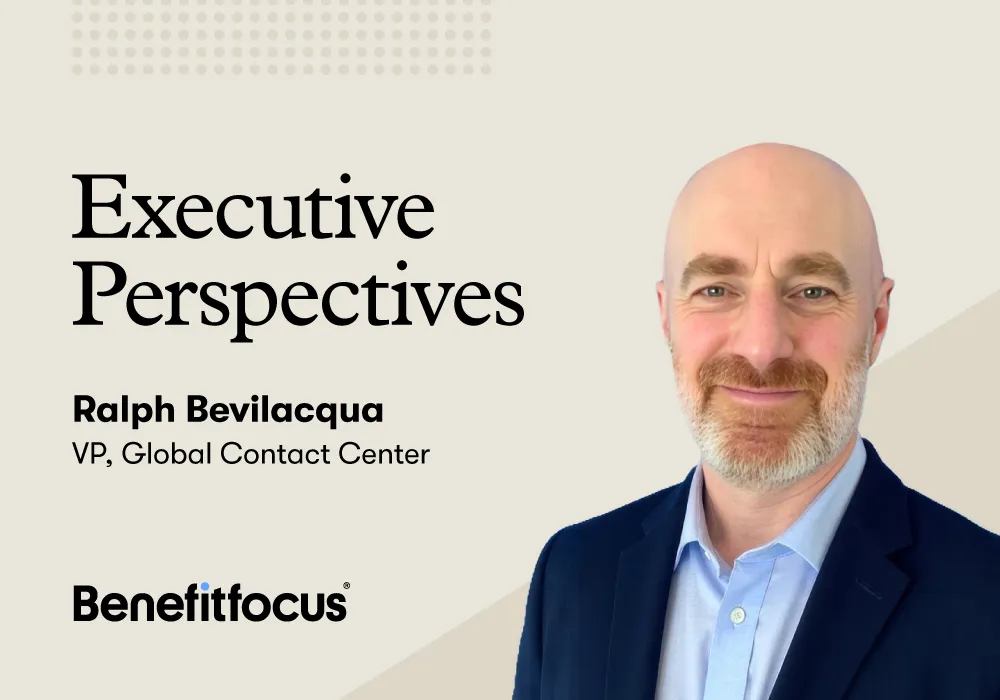
Benefitfocus is transforming member support by building a unified, well-governed foundation before applying Artificial Intelligence (AI). Ralph Bevilacqua, VP of Global Contact Center, shares how this method has enabled technology to help support the people at the center of member interactions. This blog details the following insights:
- How Benefitfocus unified staff, platforms and security in a "foundation year" before scaling AI.
- The process of predictive routing, which matches each caller with the optimal agent.
- AI auto summarization and quality scoring that help reduce manual work and enable proactive coaching.
- Expected outcomes that include members gaining faster resolution, more consistent answers and fewer handoffs.
Q: Benefitfocus has been implementing a major shift in how it structures its contact center operations. What’s the story behind that shift, and why now?
Ralph: This was really about getting the fundamentals right before we tried to scale anything. In 2025, our primary focus was integration. We called it our foundation year and the goal was to bring all staff under one organization, move to a single platform and update our security infrastructure. We weren’t rushing towards the newest technology. The priority was building the kind of consistent, well-governed operational base that enables you to layer in AI and automation in a meaningful way.
When supporting clients across multiple product lines, fragmentation can quickly undermine the consistent service experience we aim to deliver. Strong first call resolution (FCR) rates and customer satisfaction (CSAT) scores are key indicators of service quality. We needed one service model, one set of tools and the ability to flex our teams wherever demand required. Every decision we made was driven by the clarity of purpose – consistency, simplicity and end-to-end accountability.
Q: What types of structural changes were needed to implement this unified integration?
Ralph: First, we migrated our platform from Amazon Web Services (AWS) to Genesys Cloud. This enterprise-grade environment provides stronger product support and the flexibility to handle a much wider range of customer interactions. That move also unlocked enhanced self-service through voice automation, which is designed to reduce avoidable contacts and let us direct more of our human capacity toward the interactions that genuinely need a person.
We also developed what we call a universal functional role. This means that all of our customer service associates now have access to the same applications, governed by rules-based security. That structure enables us to build true end-to-end servicing teams for clients rather than routing members through disconnected silos.
And because we operate as a fully remote organization, this model also expands how we recruit and staff. We can attract talent nationally and cover extended hours across time zones, which is intended to directly benefit the members we serve.
Q: AI is clearly central to this transformation. Walk us through what’s actually live today — what are members and agents experiencing right now?
Ralph: We’ve moved quickly, and we’re proud of what’s already in production. The first capability we launched was predictive routing. Rather than connecting a caller with the next available agent, predictive routing uses factors such as handle time, skill alignment and interaction history to help route callers to an appropriate agent. It sounds like a small distinction, but it is intended to support a more informed connection for both the member and the agent from the very first moment of a call.
The second live capability is AI auto summarization. After a call, AI automatically generates structured, formatted notes that include a clean summary of the interaction, the reason for the call, the resolution, any action items and even sentiment signals. Think of it as your meeting notes auto-generated in real time and it removes a manual task that used to fall entirely on the agent after every single interaction.
Building on that, we also have AI Insights live. This takes summarization a step further by giving leaders visibility into what’s actually happening across thousands of interactions, not just a sample. This helps us identify friction points earlier, surface patterns that likely wouldn’t be visible otherwise and support improvements before issues become more significant.
Q: What capabilities are you testing right now, and what problems are they designed to solve?
Ralph: Two in particular are showing real promise. The first is AI suggested knowledge, and the context here is important: today, the average call runs about nine minutes and twenty-seven seconds, and two to four of those minutes are often spent searching for information.1 That’s a substantial portion of every interaction spent on manual effort rather than on the member.
AI suggested knowledge is designed to present relevant templates and resources based on what is happening in the conversation in real time. Instead of requiring agents to search for information on their own, the capability can help bring potentially relevant information closer to them at the time of need. This may help reduce manual effort to help them better lead with empathy and confidence.
The second is AI suggested checklists. For regulated or higher-risk tasks, the system automatically proposes an appropriate checklist. It guides agents through required validations, disclosures and documentation before a call closes. It is used to help standardize execution across teams, reduce variance and create an auditable trail that supports both quality assurance and compliance. This will support fewer errors, stronger compliance posture and smoother audits.
Q: There’s often an underlying concern when organizations talk about AI and automation: what does this mean for the people doing the work? How do you think about that?
Ralph: It’s a fair question, and we want to be clear: the goal is not to replace people. The goal is to reduce the manual work and avoidable contacts that prevent agents from doing their best work. When an agent spends the first three minutes of a call searching a knowledge base, that’s three minutes they’re likely not fully present with the member in front of them.
We want automation handling routine activities, such as the lookups, note-taking and checklist verification. And we want our people focused on the high-stakes moments that require human presence and judgment, like with the member who’s confused and frustrated or for a complex enrollment question. In these situations, empathy from the agent matters as much as accuracy.
Across every capability we’ve built, the theme is consistent: remove some of the manual effort so agents can stay present with the customer. That’s not just a technology story, that’s a service transformation story, and people remain at the center of it.
Q: Looking ahead, what does the contact center of the future look like at Benefitfocus?
Ralph: We’re moving toward a model where automation and human expertise operate in genuine partnership. The next steps are using AI to perform manual, repetitive administrative tasks, such as searching for knowledge articles so live agents can focus on the member interaction and provide empathetic support with accurate first-time resolution.
The practical outcomes expected for clients and members is faster resolution, more consistent answers, fewer handoffs and more effective peak support during enrollment. These outcomes are possible because we have the flexibility to scale capacity and skills across product lines in ways we simply couldn’t before.
What we hope clients take away is that this wasn’t built as a technology demonstration. We didn’t layer AI on top of a fragmented service model and call it innovation. We built the foundation first with consistent workflows, unified tooling and clearer security. Then we applied AI in a governed, repeatable way. That sequencing is what helps make the results sustainable.
The future of member support is one where people get the right answer, from the right person, at the right time, with technology working in the background and intended to make that possible every single time.